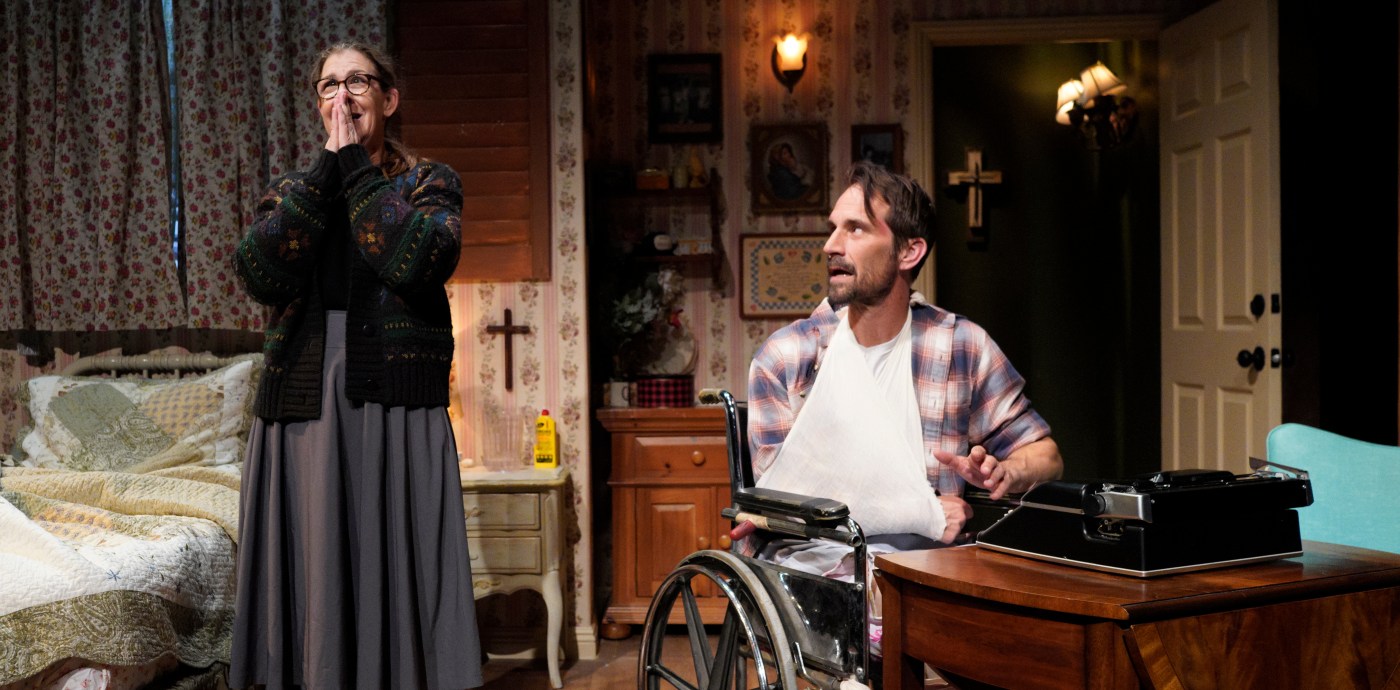
Horror is a tough genre to crack. It is wildly successful in novels, sometimes successful in film (the Academy doesn’t tend to recognize horror all that often), and not very familiar to modern theatre-goers. However, when a story is captivating enough, it’ll enthrall any audience, and this is particularly true for Stephen King’s “Misery,” which has found success in novel, film and theatre adaptation. The story, by nature, is perfect for the stage, requiring only one set and three actors. Backyard Renaissance Theatre and director MJ Sieber have brought this chilling tale to San Diego this holiday season, and the finished product is quite shocking (in the best possible way).
The play is written by the 1990 film screenwriter William Goldman, and the versions remain relatively similar. Famous romance novelist Paul Sheldon (Francis Gerke) wakes up from a car crash to find that he has been saved by Annie Wilkes (Maggie Carney), his self-described number-one fan. What begins as a simple kinship between an injured man and a kind caretaker slowly devolves into an obsession-driven hostage situation from which Paul feels there is no escape. The cast is rounded out by a visit from Buster (Alex Guzman), a local state trooper looking for Paul.
First and foremost, the acting is phenomenal. All three actors do a spectacular job of instilling a sense of normalcy and daily life into the beginning of this story, only to see them slowly develop into terrified, helpless and evil people. Gercke, in particular, does a great job of relaying honest-to-god pain that caused the audience to viscerally react every time he was forced to drag himself across the room. His back-and-forth with Annie became a game of chess, and watching him play his next move always led to hope that Paul Sheldon might finally escape. Carney was brilliant as Annie Wilkes. She alternated between someone who loved and adored Paul and someone who hated him just as equally: a split personality that could shift at the drop of a hat. Shoutout to Guzman, who highlighted what is possibly the best and most shocking moment of the entire production.
The set by Yi-Chien Lee is compact enough to fit in the black box space but designed to show depth to the house and allow room for the actors to breathe. Curtis Mueller’s lighting design and Logan Kirkendall’s sound design paired together brilliantly to create an atmosphere of, well, fear. Meanwhile, Jeffrey Neitzel’s special effects absolutely steal the show and bump this production up from scary to downright terrifying at times.
A few spots faltered, and it’s difficult to tell if they were acting choices, directorial choices or elements written into the script. Many moments of this production took scenes or lines that felt tense and instead played them for laughs. Anger would begin to rise, and suspense would grow, only for it to be undercut with humor instead of horror. In short, the production could have been a bit scarier.
The script itself is also weaker than its film counterpoint. The stage version is desperately missing an introduction or preamble to the story. The play begins with Paul already injured in Annie’s room with no lead up to establish the gravity of the situation. It’s very difficult to actively create a car wreck on stage, especially when dealing with one single set, but seeing as how the end of the play takes place outside of the set, the beginning of the story could have had a nice bookend and followed suit.
If you’re a fan of Stephen King, this production is a fun and fitting adaptation. Backyard Renaissance likes to push boundaries with their plays, and “Misery” is no exception. Just like its location at the Tenth Avenue Arts Center, the play is intimate and tailor-made for theatre fans. If you’re looking for something a little stronger than a straight drama, this production is sure to enthrall any horror lover.
(Photo Credit: Daren Scott)

 To See or Not To See
Leave a comment